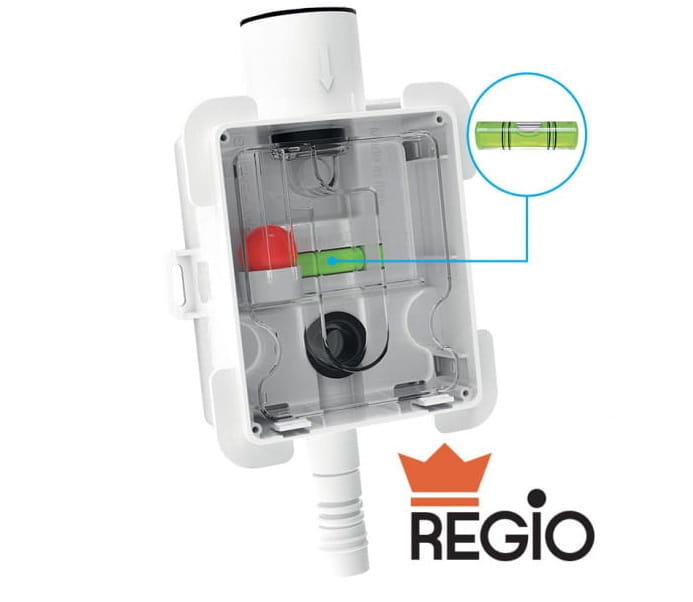
Regio Dry Siphon Ball-Type Concealed Condensate Drain
Regio Dry Siphon Ball-Type Concealed Condensate Drain
incl. VAT + shipping costs

Crowd
Description
Description
The Regio dry trap is a condensate drain for concealed installation, with a ball valve. A dry trap operates without a water seal: the barrier against odors from the wastewater pipe is formed mechanically and thus remains effective even if no condensate is produced for an extended period. The trap is installed flush with the masonry wall and closed with a cover after plastering.
Design and Features
- Ball valve: odor barrier without a water seal
- Concealed installation: flush installation in the masonry wall
- Transparent inner part: removable, for inspection and cleaning
- Two covers: a renovation cover and a visible cover
- Integrated spirit level: for alignment during installation
- Mounting: on the wall or on a vertical mounting rail
- Pipe connection: via M.T.G. reducing sleeves from Ø 16 to Ø 40
Scope of Delivery
- 1x Regio dry trap for concealed installation
- Renovation cover and visible cover
What You Need in Addition
- Reducing sleeve suitable for the diameter of your condensate pipe
- Connection to the wastewater pipe
- Wall recess for concealed installation
- Installation by a specialist company
Technical Data
| Series | Regio |
| Design | Dry trap with ball valve, concealed installation |
| Dimension A | 55 mm |
| Dimension B | 120 mm |
| Dimension C | 230 mm |
| Dimension D | 46.5 mm |
| Dimension E | 21 mm |
| Pipe connection | M.T.G. reducing sleeves Ø 16 to Ø 40 |
| Inner part | transparent, removable |
| Covers | Renovation cover and visible cover |
| Installation | Wall or vertical mounting rail |
Frequently Asked Questions
What is a dry trap?
A trap that forms the odor barrier mechanically, in this case with a ball valve, rather than with standing water. This barrier thus remains effective even when no condensate flows through the pipe.
Where is the trap installed?
Concealed, flush with the masonry wall. It is mounted on the wall or on a vertical mounting rail. After plastering, it is closed with the visible cover.
Can the trap be cleaned after installation?
The inner part is transparent and removable, so the trap can be inspected and cleaned without opening the wall.
Which pipe diameters can be connected?
The connection is made via M.T.G. reducing sleeves in the range of Ø 16 to Ø 40. The suitable sleeve depends on the diameter of your condensate pipe.
What are the two covers used for?
The renovation cover is used during the construction phase, while the visible cover remains visible after plastering.
What is the integrated spirit level used for?
It is used for alignment during installation. A horizontally aligned housing is required for the valve to operate properly and for the cover to sit flush later.
Can I install the trap myself?
The installation takes place in the masonry wall and at the connection to the wastewater pipe, i.e., before plastering. Installation and coordination with the construction schedule are carried out by a specialist company.
Important NOTE
Important NOTE
Dear Customer, please note that by purchasing this product, the buyer/user confirms compliance with Regulation (EU) No 517/2014 of the European Parliament and of the Council of 16 April 2014 on fluorinated greenhouse gases and Regulation (EU) No 573/2024 of the European Parliament and of the Council of March 2024 on fluorinated greenhouse gases, which stipulates the following: The person who buys/uses the split air conditioner confirms that it will be professionally installed by certified professionals.
F-Gas Regulation Download Declaration